

What is carbon capture and storage (CCS)?
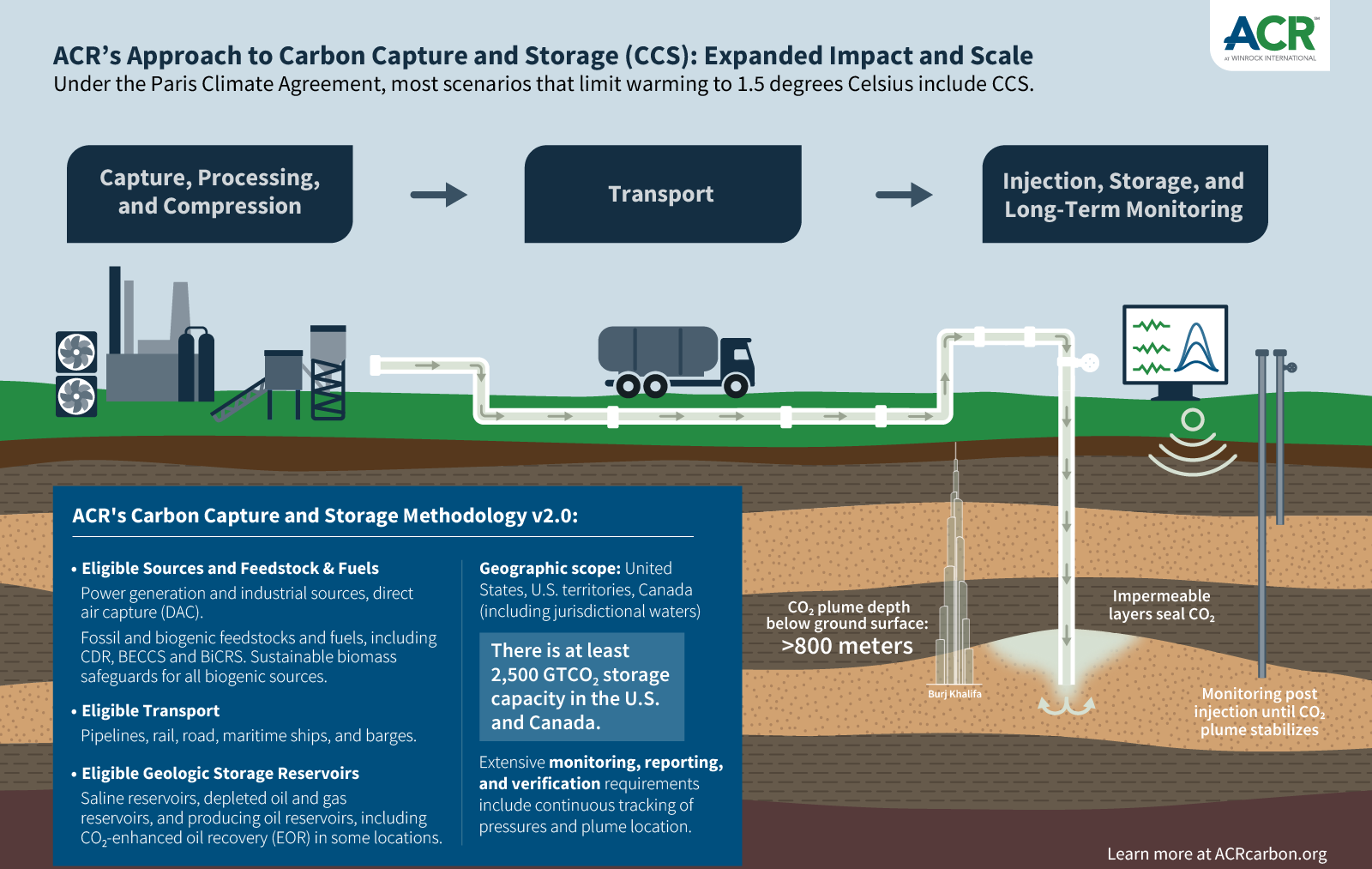


Carbon capture and storage (CCS) involves capturing carbon dioxide (CO2) that would otherwise be released into the atmosphere, or is already present in the atmosphere, and injecting it underground for permanent storage in geologic reservoirs. Most of the IPCC’s modelled pathways that limit warming to 1.5 degrees C include the use of CCS.
The three segments to a CCS project
A CCS project has three main segments. First comes capture, processing, and compression. The carbon dioxide is captured from power generation or industrial sources before it enters the atmosphere or pulled directly from ambient air through direct air capture (DAC). Next is transport, most commonly by pipeline, but also by rail, road, maritime ship, barge, or intermodal transport. Finally comes injection, storage, and long-term monitoring. The CO2 is injected at least 800 meters below ground surface, about as deep as the Burj Khalifa is tall. There, porous rocks such as sandstones can absorb and retain large volumes of it, and one or more impermeable layers such as shales act as seals.
ACR’s Carbon Capture and Storage Methodology v2.0
ACR’s Carbon Capture and Storage Projects Methodology v2.0 provides the framework for creating carbon credits from CCS projects in the United States, U.S. territories, and Canada. It can generate both emission reductions and removals credits.
Version 2.0 expands eligible storage to saline reservoirs and depleted oil and gas reservoirs. It also covers producing oil reservoirs with CO2-enhanced oil recovery (EOR) in limited locations. There is at least 2,500 billion metric tons CO2 of storage capacity in the U.S. and Canada. Eligible CO2 now includes fossil and biogenic fuels, DAC, and CO2 from methane captured from landfills and livestock and wastewater digesters. All biogenic sources must meet the methodology’s requirements for sustainable biomass, which must be sourced within the U.S. or Canada.
Monitoring, reporting and verification
Every project must have a validated and verified monitoring, reporting, and verification (MRV) Plan. The plan must meet or exceed U.S. EPA Class VI requirements, regardless of jurisdiction or permit type. This includes continuous monitoring of injection pressure and tracking of the CO2 plume. Monitoring continues after injection until plume stabilization is verified, for at least five years after the crediting period ends.
To help stakeholders understand and communicate about CCS, ACR created the infographic above. You can download it for use in your own communications and work here.