

News Category: Program Announcements
What is carbon capture and storage (CCS)?
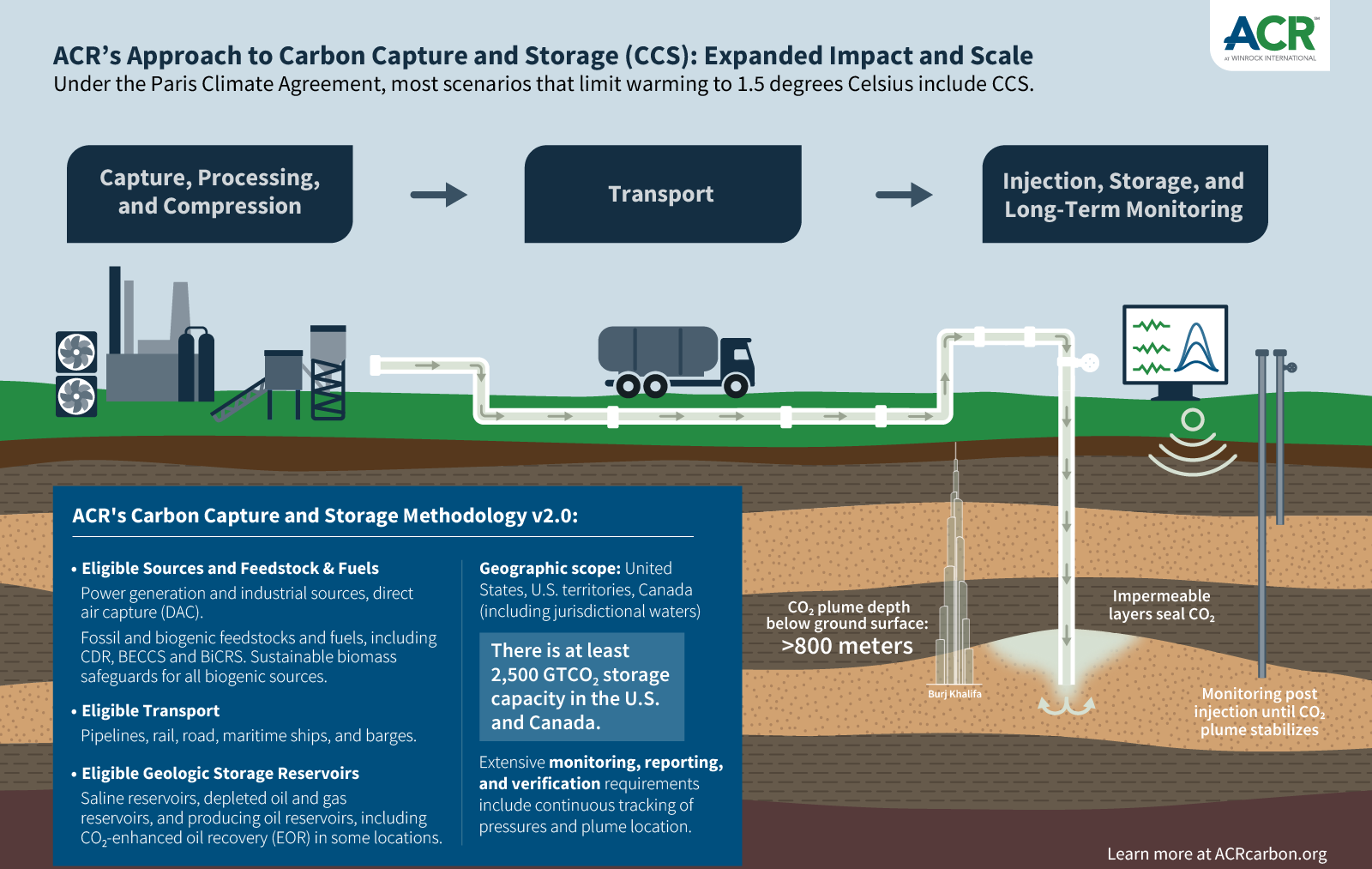


Carbon capture and storage (CCS) involves capturing carbon dioxide (CO2) that would otherwise be released into the atmosphere, or is already present in the atmosphere, and injecting it underground for permanent storage in geologic reservoirs. Most of the IPCC’s modelled pathways that limit warming to 1.5 degrees C include the use of CCS.
The three segments to a CCS project
A CCS project has three main segments. First comes capture, processing, and compression. The carbon dioxide is captured from power generation or industrial sources before it enters the atmosphere or pulled directly from ambient air through direct air capture (DAC). Next is transport, most commonly by pipeline, but also by rail, road, maritime ship, barge, or intermodal transport. Finally comes injection, storage, and long-term monitoring. The CO2 is injected at least 800 meters below ground surface, about as deep as the Burj Khalifa is tall. There, porous rocks such as sandstones can absorb and retain large volumes of it, and one or more impermeable layers such as shales act as seals.
ACR’s Carbon Capture and Storage Methodology v2.0
ACR’s Carbon Capture and Storage Projects Methodology v2.0 provides the framework for creating carbon credits from CCS projects in the United States, U.S. territories, and Canada. It can generate both emission reductions and removals credits.
Version 2.0 expands eligible storage to saline reservoirs and depleted oil and gas reservoirs. It also covers producing oil reservoirs with CO2-enhanced oil recovery (EOR) in limited locations. There is at least 2,500 billion metric tons CO2 of storage capacity in the U.S. and Canada. Eligible CO2 now includes fossil and biogenic fuels, DAC, and CO2 from methane captured from landfills and livestock and wastewater digesters. All biogenic sources must meet the methodology’s requirements for sustainable biomass, which must be sourced within the U.S. or Canada.
Monitoring, reporting and verification
Every project must have a validated and verified monitoring, reporting, and verification (MRV) Plan. The plan must meet or exceed U.S. EPA Class VI requirements, regardless of jurisdiction or permit type. This includes continuous monitoring of injection pressure and tracking of the CO2 plume. Monitoring continues after injection until plume stabilization is verified, for at least five years after the crediting period ends.
To help stakeholders understand and communicate about CCS, ACR created the infographic above. You can download it for use in your own communications and work here.
ACR Issues First Credits Under Methodology for Small Non-Industrial Private Forestlands

On August 27, 2026, ACR issued the first credits to a project using its Improved Forest Management (IFM) on Small Non-Industrial Private Forestlands methodology, which provides access to carbon finance for owners of small family woodlands. Credits were issued to the LandYield Small Scale IFM Project 1 (ACR0831). This is LandYield’s first project, representing landowners across 13 states in the Southeastern U.S.
Despite owning nearly 40% of U.S. forestlands, less than 1% of small forest ownerships have enrolled in the carbon market to date. This is due to known financial and institutional barriers associated with the scale and complexity of the existing market. This methodology, developed in partnership between Finite Carbon and ACR, draws upon our collective market experience to introduce innovative aggregation, monitoring and verification approaches that alleviate these barriers.
The methodology quantifies greenhouse gas emission reductions and removals resulting from improved forest management activities on aggregated ownerships of non-industrial private forestlands, ranging from 40–5,000 forested acres. Emission reductions are quantified from forest carbon projects that exceed baseline forest management practices, and removals are quantified for retention of annual forest growth. The primary carbon sequestration mechanism is the commitment to forego harvesting, grow trees longer and increase forest stocking.
“This issuance to LandYield represents an important step forward for family woodland owners in the United States,” said Dr. Kurt Krapfl, ACR Forestry Director. “It is a priority for ACR to provide solutions for families to be able to use carbon market finance as a way to keep their forests standing and in family ownership. Today’s issuance creates another pathway to do just that.”
In addition to its methodology for small non-industrial private forestlands, ACR’s IFM on Non-Federal U.S. Forestlands methodology allows for aggregation, which provides a separate path for family woodlands to access carbon markets.
For more information about ACR’s methodology, visit https://acrcarbon.org/methodology/improved-forest-management-ifm-on-small-non-industrial-private-forestlands/.
###
ACR Improved Forest Management Methodology Version 1.3 Earns Core Carbon Principle (CCP) Approval from the Integrity Council for the Voluntary Carbon Market (ICVCM)
ACR’s Improved Forest Management (IFM) on Non-Federal U.S. Forestlands methodology version 1.3 has earned Core Carbon Principles (CCP) approval from the Integrity Council for the Voluntary Carbon Market (ICVCM) in the latest round of methodology assessments. ACR IFM v1.3 credits eligible for the CCP Approved label include removals credits and emission reduction credits verified using ACR’s Tool for Dynamic Evaluation of Baselines. The CCP Approved label will soon be applied to more than 9 million eligible IFM v1.3 credits in the ACR Registry.
ACR’s Afforestation and Reforestation of Degraded Lands (ARR) methodology earned CCP approval in July 2025, and ACR’s IFM on Non-Federal U.S. Forestlands versions 2.1 and 2.0 earned CCP approval in August 2025 and February 2026, respectively. ACR’s IFM on Small Non-Industrial Private Forestlands v1.0, IFM on Canadian Forestlands, and Active Conservation and Sustainable Management on U.S. Forestlands v1.0 methodologies are still under assessment. We will continue to engage with ICVCM throughout their assessment process with the intent of securing CCP Approved labels across our portfolio of active methodologies.
ICVCM approved ACR at the program level as “Core Carbon Principles (CCP) Eligible” in April 2024. To become approved, ACR submitted an extensive application to ICVCM for assessment. We provided evidence of being a CORSIA Eligible Emissions Unit Program, in addition to meeting the CCP’s criteria around effective governance, credit tracking, transparency, and robust, independent third-party validation and verification.
Since its founding in 1996 as the world’s first private greenhouse gas registry, ACR has innovated and operationalized key elements of carbon credit quality assurance, including scientific peer-reviewed accounting methodologies and well-accepted approaches to address additionality, leakage, and reversal risk mitigation; oversight of independent third-party verification; and operation of a transparent registry for the issuance and tracking of serialized credits.
ACR’s approach to program quality has earned approval to issue credits for use in regulated carbon markets, including the State of California’s Cap-and-Trade Program, the International Civil Aviation Organization’s (ICAO) Carbon Offsetting and Reduction Scheme for International Aviation (CORSIA), the State of Washington’s Cap-and-Invest Program, and towards compliance with Singapore’s Carbon Pricing Act.
###
Remote Sensing: Quality Unlocks Scale

By Warren Reed
In Spring 2026, ACR published a new Framework for Remotely Sensed Quantification of Forest Carbon. The Framework fulfills a longtime market need for a transparent, scientifically based benchmark against which the efficacy of remotely sensed forest carbon estimates can be assessed. As the technology continues to advance, forest carbon projects listed with ACR now have a way of integrating remote sensing into project development, monitoring and verification.
In carbon markets, quality leads to results at scale. This Framework puts quality at the forefront, with a few important goals in mind:
- Results over method. There are many ways of leveraging remote sensing to derive an estimate of forest carbon. ACR saw no need to create barriers to entry by being overly prescriptive on how estimates are made. Rather, we set benchmarks for accuracy and uncertainty against which we can directly compare results. If a remote sensing approach meets or exceeds the benchmarks, it can be used.
- Scale matters. Forests are diverse and the accuracy of remote sensing estimates vary by circumstance. As a registry we have a portfolio of forest carbon projects that spans biomes. Assessing remote sensing models at the scale at which they are utilized ensures project-specific quality and rigor.
- Efficiencies lead to impact. Remotely sensed technologies offer great potential to increase accessibility to the carbon market. Leveraging remotely sensed estimates of forest carbon has potential to lower the barrier to entry and lead to higher rates of development of forest carbon projects using ACR methodologies.
As reliance on tech-based carbon measurement and estimation techniques advance, ACR and the carbon market need reliable assurance of their accuracy. The ACR Framework validates remotely sensed forest carbon estimates against a sub-set of field plots, setting a known and transparent benchmark for quality that aligns with market expectations.
Under the ACR Framework, quality remains front and center.
ACR Scope of Eligibility for Global Aviation’s Carbon Market Expanded to Include Electric Power Sector Credits
Credits from the Standard for the Transformation of the Electric Power Sector (STEPS) are eligible for CORSIA, marking the first eligible jurisdictional credits beyond REDD+
LITTLE ROCK, Ark.—Internationally recognized carbon crediting program ACR, a nonprofit enterprise of Winrock International, announces the finding of the International Civil Aviation Organization (ICAO) that units generated under the Standard for the Transformation of the Electric Power Sector (STEPS) are consistent with ACR’s existing ICAO approval, thus extending the scope of eligibility of ACR-issued credits for compliance under the Carbon Offsetting and Reduction Scheme for International Aviation (CORSIA) to include STEPS Credits. This is significant as it marks the first CORSIA Eligibility determination of a sectoral carbon crediting approach beyond the landmark approval of jurisdictional REDD+ in 2020. ACR will manage the implementation of STEPS alongside ACR’s existing project-based crediting program, which focuses on forestry, super pollutants and CCS.
STEPS is a first-of-a-kind jurisdictional-scale, sector-wide carbon crediting standard that aims to incentivize host country investment, planning and policies to deliver long-term structural changes necessary for electric power sector emissions to peak sooner and decline faster to meet Paris Agreement temperature targets. STEPS’ goal is to catalyze large-scale investment needed to achieve the clean energy transition, while ensuring energy equity and energy security.
The CORSIA Eligibility of STEPS Credits signals an important milestone for ICAO’s global compliance carbon market to support accelerating the energy transition. The International Energy Agency (IEA) indicates that clean energy investment in developing and emerging economies, excluding China, must increase seven-fold to $1.9 trillion a year by the early 2030s to keep a 1.5°C limit on warming within reach and avert catastrophic climate impacts on communities worldwide.
“We applaud the news that ACR’s scope of CORSIA Eligible credits now includes STEPS Credits, as consistent with ICAO’s Emissions Unit Criteria,” said Mary Grady, Executive Director of ACR. “The energy transition is a massive emissions mitigation opportunity that requires access to finance at scale to deliver Paris Agreement-aligned results. Sector-level crediting can mobilize capital at the scale needed to support investments in grid expansion and storage infrastructure, as well as concessionary finance to address the needs of communities and workers affected by the transition from fossil fuels. We look forward to working with governments to implement STEPS and are encouraged that ACR is able to advance the potential to attract critical climate finance to meet the challenges of power sector decarbonization while ensuring economic development, energy security and energy access.”
ICAO is a specialized agency of the United Nations that manages the standards that govern international aviation. In 2016 ICAO approved CORSIA as a global market-based mechanism to achieve carbon-neutral growth in international aviation starting in 2020. ACR is among the ten global carbon crediting programs approved by ICAO to supply offset credits for CORSIA’s 2024-2026 phase and among only four currently approved to supply credits for the 2027-2029 phase.
For more on STEPS, visit https://www.stepsclimate.org/.
ACR Improved Forest Management Methodology Version 2.0 Earns Core Carbon Principle (CCP) Approval from the Integrity Council for the Voluntary Carbon Market (ICVCM)

ACR’s Improved Forest Management (IFM) on Non-Federal U.S. Forestlands methodology version 2.0 has earned Core Carbon Principles (CCP) approval from the Integrity Council for the Voluntary Carbon Market (ICVCM) in the latest round of methodology assessments.
ACR IFM 2.0 credits eligible for the CCP label include removals credits and emission reduction credits quantified using ACR’s Tool for Dynamic Evaluation of Baselines. The CCP label will soon become active for 2.7 million eligible IFM 2.0 credits in the ACR Registry.
ACR’s Afforestation and Reforestation of Degraded Lands (ARR) methodology earned CCP approval in July 2025, and ACR’s IFM on Non-Federal U.S. Forestlands version 2.1 earned CCP approval in August 2025. ACR’s IFM on Non-Federal U.S. Forestlands v1.3, IFM on Small Non-Industrial Private Forestlands v1.0, and Active Conservation and Sustainable Management on U.S. Forestlands v1.0 methodologies are still under assessment.
ACR views the most recent CCP approval as a step forward in the ICVCM process and we will continue to engage with ICVCM throughout their assessment process with the intent of securing CCP-Approved labels across our portfolio of active methodologies, which includes emission reductions and removals from nature-based and industrial solutions.
ICVCM approved ACR at the program level as “Core Carbon Principles (CCP) Eligible” in April 2024. To become approved, ACR submitted an extensive application to ICVCM for assessment. We provided evidence of being a CORSIA Eligible Emissions Unit Program, in addition to meeting the CCP’s criteria around effective governance, credit tracking, transparency, and robust, independent third-party validation and verification.
Since its founding in 1996 as the world’s first private greenhouse gas registry, ACR has innovated and operationalized key elements of carbon credit quality assurance, including scientific peer-reviewed accounting methodologies and well-accepted approaches to address additionality, leakage, and reversal risk mitigation; oversight of independent third-party verification; and operation of a transparent registry for the issuance and tracking of serialized credits.
ACR’s approach to program quality has earned approval to issue credits for use in regulated carbon markets, including the State of California’s Cap-and-Trade Program, the International Civil Aviation Organization’s (ICAO) Carbon Offsetting and Reduction Scheme for International Aviation (CORSIA), the State of Washington’s Cap-and-Invest Program, and towards compliance with Singapore’s Carbon Pricing Act.
Alongside ACR’s approval in global compliance markets, we expect the ICVCM’s CCP label to provide further confidence to buyers in credit quality and allow finance to flow to impactful climate solutions to support the goals of the Paris Agreement. The urgency of climate change demands nothing less.
###
ACR Approved by ICAO for 2027-2029 CORSIA Compliance Period

Approval demonstrates that ACR meets the high bar for quality in the global aviation carbon market
LITTLE ROCK, ARK – ACR is pleased to announce that at its October 2025 session, the Council of the International Civil Aviation Organization (ICAO), the United Nations’ main aviation body, approved ACR to supply carbon credits for the Second Phase of the Carbon Offsetting and Reduction Scheme for International Aviation (CORSIA), covering the period 2027–2029.
The decision confirms that all of ACR’s active methodologies are eligible to supply credits for use in CORSIA’s Second Phase. This latest approval builds on ICAO’s previous decisions to recognize ACR-issued credits for CORSIA’s Pilot Phase (2021–2023) and First Phase (2024–2026).
“We are proud that ACR has once again successfully completed a thorough review of our program requirements and oversight and that ICAO has approved ACR-issued credits for use in both CORSIA’s First and now Second Phase,” said Mary Grady, Executive Director of ACR. “ICAO’s most recent approval reflects our ongoing alignment with Paris Agreement rules and ICAO requirements in a rapidly evolving market landscape.”
ICAO is a specialized agency of the United Nations that manages the standards that govern international aviation. In 2016, ICAO approved the Carbon Offsetting and Reduction Scheme for International Aviation (CORSIA) as a global market-based mechanism to achieve carbon-neutral growth in international aviation starting in 2020. Demand for CORSIA Eligible offset credits is expected to be 1.5 billion tons of CO2-e through 2035.
ACR Improved Forest Management Methodology Earns Core Carbon Principle (CCP) Approval from the Integrity Council for the Voluntary Carbon Market (ICVCM)
ACR credits issued to projects under Version 2.1 of the methodology now eligible for CCP-Approved Label.
ACR’s Improved Forest Management (IFM) on Non-Federal U.S. Forestlands methodology has earned Core Carbon Principles (CCP) approval from the Integrity Council for the Voluntary Carbon Market (ICVCM) in the latest round of methodology assessments. Carbon credits issued to projects under Version 2.1 of the methodology are eligible for CCP-Approved status.
The CCP label is active in the ACR Registry. While ACR has not yet issued credits to projects under IFM version 2.1, there are 18 projects listed under this version, covering nearly 500,000 acres of forestland. Earlier versions of ACR’s Improved Forest Management methodology are still under assessment.
While ACR views this as an important step forward, we will continue to engage with ICVCM throughout their assessment process with the intent of securing CCP-Approved labels across our portfolio of active methodologies, which includes emission reductions and removals from nature-based and industrial solutions.
ICVCM approved ACR at the program level as “Core Carbon Principles (CCP) Eligible” in April 2024. To become approved, ACR submitted an extensive application to ICVCM for assessment. We provided evidence of being a CORSIA Eligible Emissions Unit Program, in addition to meeting the CCP’s criteria around effective governance, credit tracking, transparency, and robust, independent third-party validation and verification.
Since its founding in 1996 as the world’s first private greenhouse gas registry, ACR has innovated and operationalized key elements of carbon credit quality assurance, including scientific peer-reviewed accounting methodologies and well-accepted approaches to address additionality, leakage, and reversal risk mitigation; oversight of independent third-party verification; and operation of a transparent registry for the issuance and tracking of serialized credits.
ACR’s approach to program quality has earned approval to issue credits for use in regulated carbon markets, including the State of California’s Cap-and-Trade Program, the International Civil Aviation Organization’s (ICAO) Carbon Offsetting and Reduction Scheme for International Aviation (CORSIA), the State of Washington’s Cap-and-Invest Program, and towards compliance with Singapore’s Carbon Pricing Act.
Alongside ACR’s approval in global compliance markets, we expect the ICVCM’s CCP label to provide further confidence to buyers in credit quality and allow finance to flow to impactful climate solutions to support the goals of the Paris Agreement. The urgency of climate change demands nothing less.
###
ACR is an internationally recognized carbon crediting program that operates in global compliance and voluntary carbon markets. A nonprofit enterprise of Winrock International, ACR was founded in 1996 as the first private greenhouse gas (GHG) registry in the world with the mission of harnessing the power of markets to improve the environment. Learn more at ACRclimate.org.