

New research on forest carbon leakage supports ACR’s approach



 By Kurt Krapfl, PhD
A highly anticipated peer reviewed publication on leakage in forest carbon projects, recently published in Environmental Research Letters, reinforces ACR’s existing approach as science-based and conservative. Continued research is needed to support the application of more precise and consistent approaches to leakage accounting across the market.
Leakage rates vary based on project factors
Leakage refers to the unintended increase in greenhouse gas emissions outside the boundary of a forest carbon project due to the project activity, such as reduced harvest levels, increased rotation lengths, or set asides.
The most recent publication on forest carbon leakage from Daigneault et al. (2025)1 used an economic modeling approach to examine leakage dynamics in forest carbon projects.
The paper has several important findings relevant to the carbon market.
The study confirms that forest carbon projects do not automatically lead to carbon leakage and in some cases may cause little to no leakage or even positive leakage (i.e., market spillover effects that spur investments in storing more carbon on the landscape).
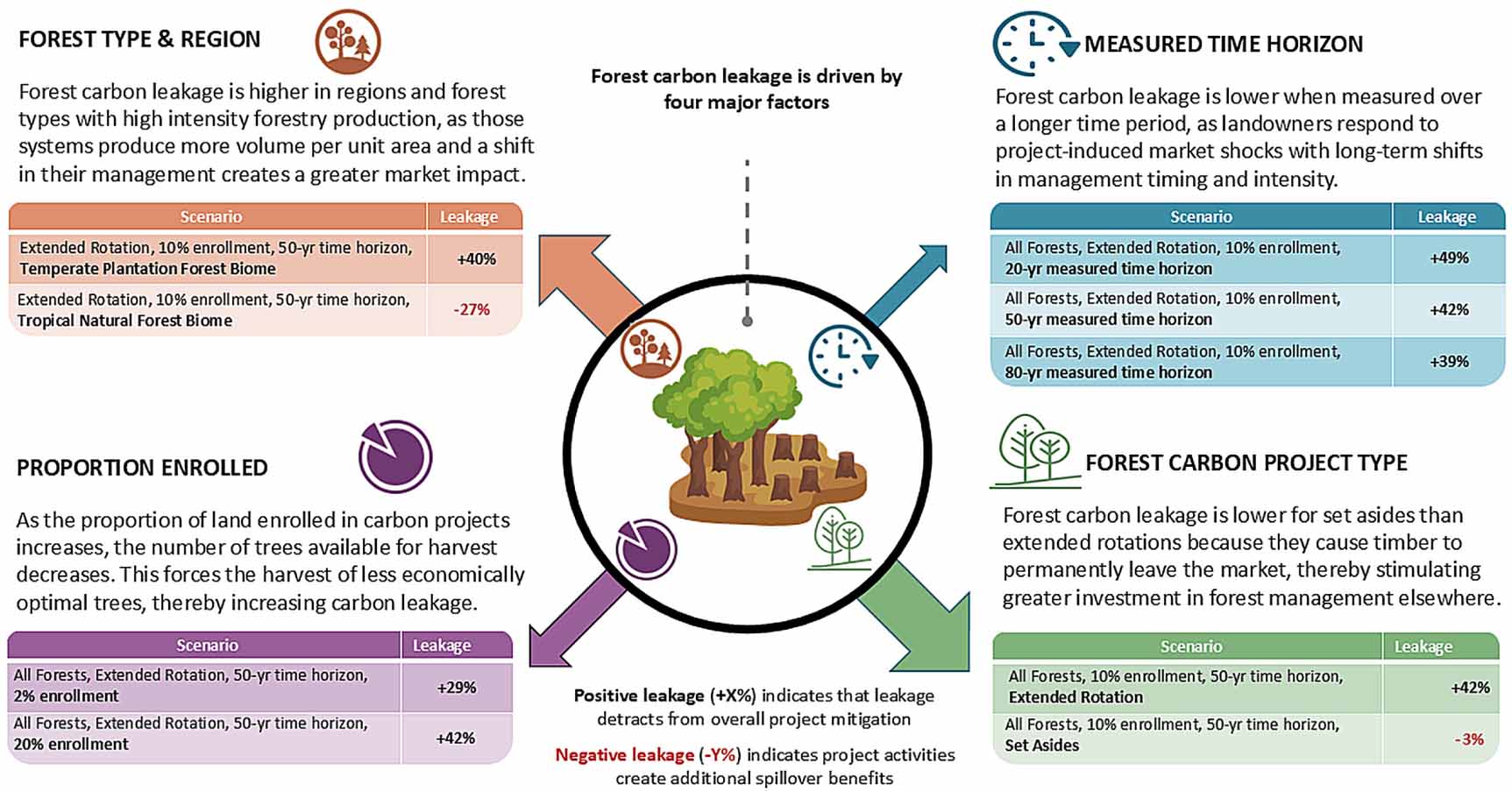
The study also supports what many practitioners in the forest carbon market have anticipated for years – that forest carbon leakage varies based on project attributes. Despite this complexity, the carbon leakage rates in Daigneault et al. align well with the existing ACR leakage deductions.
The study also supports what many practitioners in the forest carbon market have anticipated for years – that forest carbon leakage varies based on project attributes. Despite this complexity, the carbon leakage rates in Daigneault et al. align well with the existing ACR leakage deductions.
Figure 1, below, provides a succinct summary of the factors identified by Daigneault et al. as most influential to forest carbon leakage estimates.
Research aligns with ACR’s leakage deduction
ACR interpreted the forest carbon leakage estimates from Daigneault et al. in the context of our Improved Forest Management (IFM) methodologies, considering 1) ACR IFM operates primarily in the U.S., 2) ACR has projects incorporating varying levels of harvesting and forest types, and 3) ACR requires a legally-binding 40-year minimum project term for continued monitoring, reporting and verification.
A simple interpretation is below:
- Table S32 provides IFM leakage estimates for six U.S. forest types: Northern Hardwood, Northern Softwood, Southern Hardwoods, Southern Pine, West, and West Valuable Softwood. Acreages for each forest type are provided in Table S5.
- The current IFM implementation rate on eligible continental U.S. lands is approximately 3.2%3,4. Rounding up to a 5% implementation rate is conservative because it yields increased leakage estimates from the study (compared to the 2% implementation rate).
- Carbon leakage rates in the study are available for a 20-year average, a 50-year average, and an 80-year average. The 50-year average most closely resembles the ACR minimum project term of 40 years.
- For a 50-year forest carbon project at 5% implementation, a weighted average leakage estimate across U.S. forest types is 29.6% for extended rotation and -0.8% for set asides (or, a 14.4% total leakage rate, if combined).
In theory, application of set aside versus extended rotation could be assessed and applied at the project level. Leakage rates could also be assigned more precisely by region.
For simplicity, averaging across forest types and applying only the extended rotation leakage rate for all projects would provide a highly conservative estimate of ACR IFM forest carbon leakage at 29.6%. This aligns with the 30% leakage deduction to total crediting applied in the ACR IFM program today.
Conclusion
As crediting programs look to integrate the latest research into policy, the first step is naturally taking stock of how the results compare to the status quo. A first look reinforces ACR’s existing approach as science-based and conservative.
While the latest paper furthers our understanding of leakage, more research is warranted.
Because real-world forest management and leakage is dynamic, future research should examine the development of leakage estimates corresponding to fluctuating rates of harvest (as opposed to the categorical grouping of “set aside” or “extended rotation”). Recommendations on where and how leakage deductions should be applied in carbon accounting frameworks – such as to specific carbon pools like harvested wood or to credits issued overall – are also needed for ensuring leakage approaches are implemented appropriately and comparably across programs.
ACR is committed to ongoing review of our approach based on the latest scientific research and lessons learned. The latest findings on leakage confirm ACR’s approach as conservative and appropriate. The urgency of climate change demands that we continue to invest in climate action now.
Kurt Krapfl, PhD, is Director of Forestry at ACR.
Footnotes:
- Daigneault, A., Sohngen, B., Belair, E., Ellis, P. 2025. A globally relevant data-driven assessment of carbon leakage from forestry. Environmental Research Letters 20(11). https://doi.org/10.1088/1748-9326/ae0ce2 ↩︎
- https://iopscience.iop.org/article/10.1088/1748-9326/ae0ce2/data ↩︎
- As of January 2026 there are 7,756,907 acres of IFM projects registered in the continental U.S. (CONUS) under ACR (3,850,354 CARB, 17,781 ECY, 3,888,772 ACR). A conservative doubling of this value to encompass IFM projects registered under CAR and VCS (which we know to be highly conservative) would result in an estimated 15,513,814 acres registered in IFM projects in the CONUS. From FIA data, there is 678,389,782 acres of CONUS forestland and 489,361,771 acres excluding federal ownership (https://apps.fs.usda.gov/fiadb-api/evalidator). 15,513,814 IFM acres / 489,361,771 eligible acres = 3.2% Implementation Rate. ↩︎
- Alaska and Canada currently have relatively lower IFM uptake on a per acre basis relative to CONUS, such that it is conservative to omit these regions from this analysis and reduce the denominator used to calculate implementation rate and thereby arrive at higher estimated carbon leakage rate from the study. ↩︎